iPhone Space Exploration Games: Offline & Ad-Free in 2026
 by Galaximus
iPhone Space Exploration Games: Offline & Ad-Free
Most space games on the App Store follow the same playbook: free-to-play loop, energy meters, battle passes, ads between every action. If you want to pilot a ship through real gravity without interruption, without watching a 30-second ad to refuel, without hitting a paywall every 10 minutes, your options have narrowed to a handful of genuinely premium titles. This guide covers what actually exists in that space—and why the model matters as much as the gameplay.
Why Offline & Ad-Free Space Games Matter
The difference between a free-to-play space game and a premium one isn’t just cosmetic. Free-to-play design optimizes for engagement metrics and monetization funnels, which means the game’s pacing, resource costs, and progression are engineered to frustrate you into spending. You’ll hit a wall at level 8 that takes 16 hours to pass naturally, or you can pay. The game’s economy is the actual product; you’re the customer being optimized.
Premium space games are different. The developer gets paid once, upfront. The game’s economy—if it has one—exists to make the experience better, not to extract more money. You can play for three hours straight without a single interruption. No ads. No “come back in 8 hours.” No premium currency you can’t earn. The game respects your time because it’s already been paid for.
On iPhone, this matters more than on console or desktop. Your phone is always with you, always connected. The pressure to monetize is constant. Games that resist it are rare enough to be worth seeking out.
Premium Space Games: Quick Picks
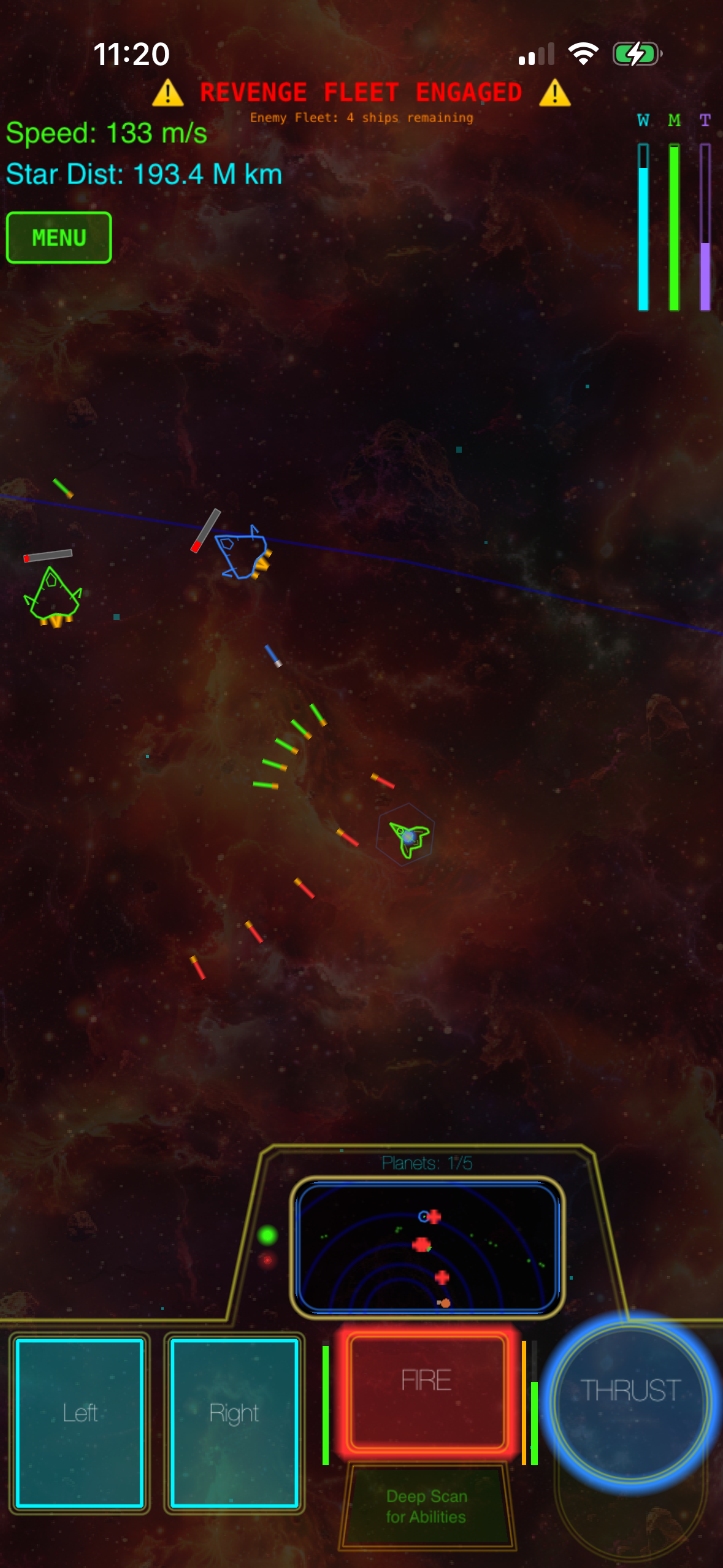
Galaximus ( USD / £7.99 GBP) — Best for arcade-action orbital flight. Real-time gravity simulation, synthesized audio, 8-system campaign with procedurally varied configurations per playthrough. Offline-only. No ads, no IAP. 8–12 hours per campaign. Includes Infinitum expansion (launching late 2026) at no extra cost if purchased before expansion release.
Kerbal Space Program ( USD on desktop; USD on mobile) — Best for learning orbital mechanics and rocket engineering. Part-by-part spacecraft assembly, realistic delta-v calculations, mission-based progression. Steeper learning curve than Galaximus. Desktop version more feature-complete; mobile version streamlined but functional. Offline-capable after initial download.
No Man’s Sky ( USD / £24.99 GBP) — Best for large-scale exploration and planet walking. Procedurally generated galaxies, base building, multiplayer. Requires internet connection for multiplayer features; single-player works offline after initial sync. Significantly larger scope than Galaximus but less focused on orbital mechanics.
Reigns: Her Majesty ( USD / £2.49 GBP) — Best for narrative-driven space strategy. Card-based decision game set in a sci-fi kingdom. Minimal learning curve, 2–3 hour completion time. Offline-only. No ads, no IAP.
Asteroids+ ( USD / £3.99 GBP) — Best for arcade-action without orbital mechanics. Modern vector-graphics remake of Asteroids. Pure arcade gameplay, no learning curve, 5–15 minute sessions. Offline-only. No ads, no IAP.
Get Galaximus on the App Store:
What Real Orbital Mechanics Actually Changes
Most space games fake gravity for accessibility. A planet is a visual object; when your ship flies past it, nothing happens. You’re just moving through empty space with a pretty backdrop. It’s faster to program, easier to balance, and doesn’t punish the player for not understanding physics.
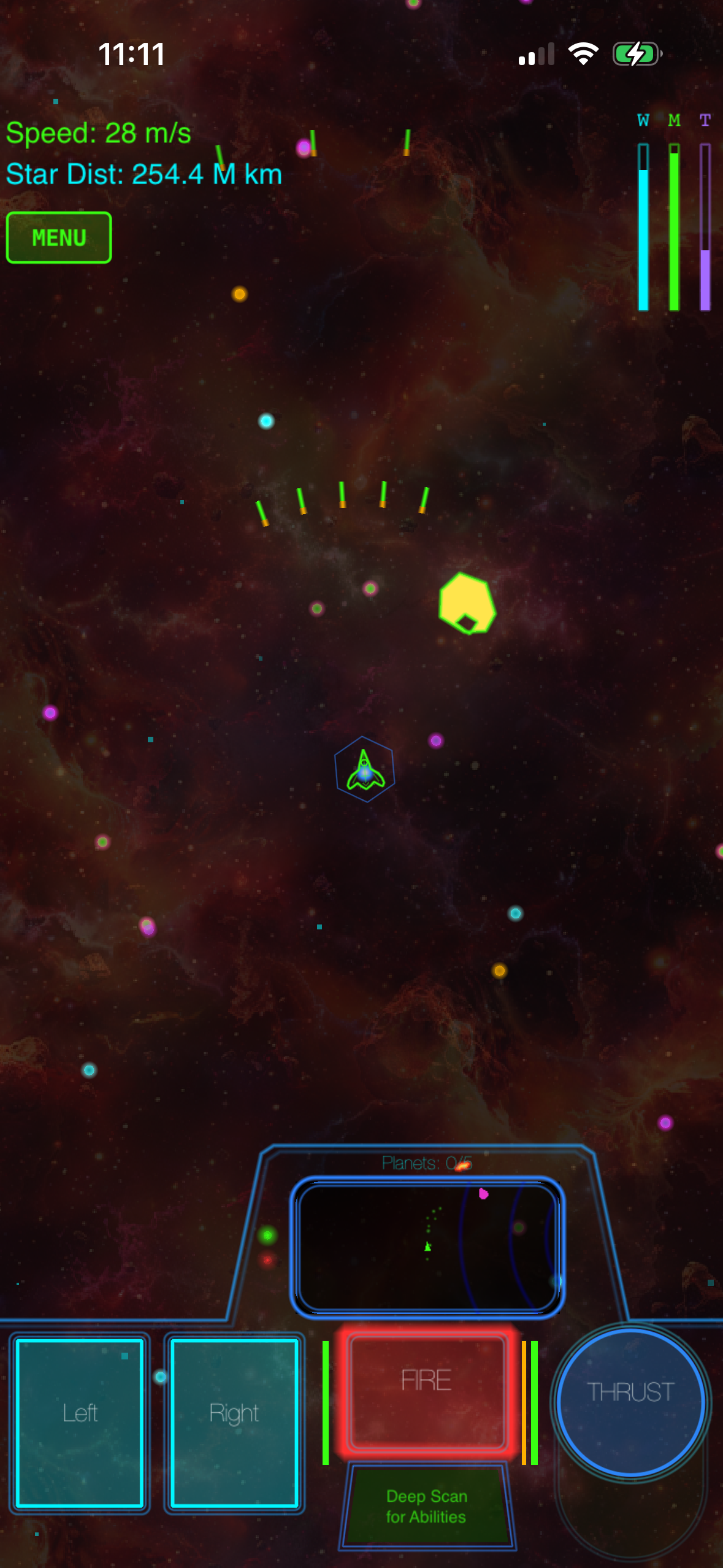
Galaximus uses real-time gravity simulation. Planets orbit suns. Moons orbit planets. Asteroids tumble through gravity wells. Your ship is subject to all of it.
What this means in practice:
- Slingshot maneuvers aren’t scripted events. You approach a planet at the correct angle and velocity, and gravity accelerates your ship without fuel burn. This is exploitable once you understand the mechanic—mastery comes from positioning, not reflexes.
- Fuel management becomes strategic. Burning fuel to fight gravity is wasteful. Learning to use gravity wells instead of engines is the core skill progression.
- Mission variety changes. In faked-physics games, all missions feel similar: fly to waypoint, trigger event, return. In gravity-based games, reaching the same waypoint from different angles requires different approaches. A planet in your path is either an obstacle to avoid or a tool to use.
Compare this to Kerbal Space Program, where the learning curve is steeper but the reward is understanding real orbital mechanics well enough to design multi-stage rockets and plan Hohmann transfers. KSP teaches engineering; Galaximus teaches piloting.
The learning curve in Galaximus is real. Gravity is unintuitive if you’ve never thought about it. The first system is designed to build intuition through repeated exposure. By the second system, the physics feels natural.
The Premium Model: What You Actually Get
When you buy Galaximus ( USD / £7.99 GBP), you own it. No ads. No in-app purchases. No energy meter. No battle pass that resets monthly and costs money to skip. No premium currency that’s priced in a way that leaves you with 47 gems when the next item costs 50. No “complete this task in the next 6 hours or lose your streak.”
What you get instead: a complete 8-system campaign with a beginning, middle, and satisfying ending. Each playthrough generates unique planet configurations, so the experience is different each time, but the narrative arc is authored. You’re not waiting for content updates. It ships complete.
Infinitum expansion (launching late 2026) adds open-galaxy sandbox exploration. If you buy Galaximus before Infinitum launches, the expansion is included free. After launch, the combined game moves to a higher price tier ( USD / £11.99 GBP estimated). Early adopters lock in the lower price permanently.
Comparison to competitors:
- Kerbal Space Program ( USD on mobile) includes unlimited mission design but has a steeper barrier to entry. No ads or IAP, but the learning curve means many players quit before finishing their first orbital flight.
- No Man’s Sky ( USD / £24.99 GBP) is larger in scope but requires internet for multiplayer features and periodic updates. Single-player works offline but is less polished than the multiplayer experience.
- Asteroids+ ( USD / £3.99 GBP) is cheaper but offers 5–15 minute arcade sessions, not a campaign.
Offline Play: What It Actually Means
“Offline” has become a marketing term that means almost nothing. Many free-to-play games claim offline support while still requiring a server handshake every 15 minutes to validate your session. If you’re on a plane and the game can’t reach the server, you can’t progress. That’s not offline; that’s “works offline until it doesn’t.”
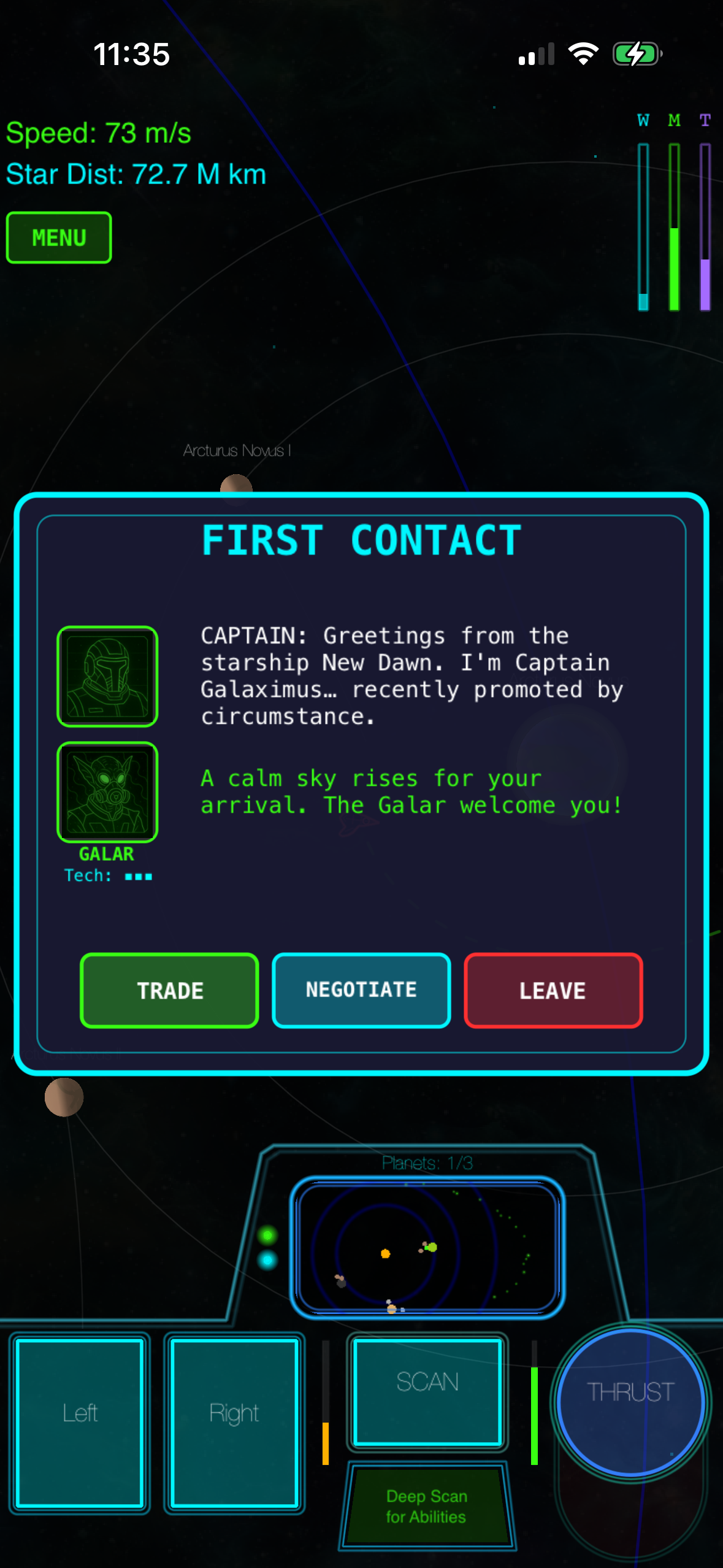
Galaximus works offline because it is offline. No server calls. No session validation. No cloud sync that breaks if you’re out of range. You download it, you play it, the game runs entirely on your device.
This is different from free-to-play offline capability. Many free-to-play games work offline after an initial download, but they’re still designed to pressure you into spending. Offline capability doesn’t change the monetization model. Premium games like Galaximus are offline and monetization-free—they’re designed to be played standalone from the ground up.
This matters more than it sounds. You can play on a plane. In a subway. In a cabin with no signal. The game doesn’t care. It’s yours, completely, in a way that cloud-dependent games can never be.
What Competitors Do Well (And Where Galaximus Fits)
Kerbal Space Program excels at teaching real orbital mechanics and rocket engineering. If your goal is to understand delta-v, Hohmann transfers, and multi-stage rocket design, KSP is the best teacher available. The learning curve is steep—expect 10+ hours before your first stable orbit—but the payoff is genuine understanding. Galaximus assumes you don’t need to know the math; you learn by flying.
No Man’s Sky offers procedural planet exploration at a scale Galaximus doesn’t attempt. Walking on planet surfaces, base building, and multiplayer exploration are core to NMS’s identity. Galaximus focuses on space flight and orbital navigation; planetary surfaces are coming in Infinitum but won’t match NMS’s depth. If exploration and base building are your priority, NMS is the better choice.
Asteroids+ is faster to pick up and play. If you want 5-minute arcade sessions with no learning curve, Asteroids+ fits better than Galaximus. No orbital mechanics to learn, pure reflex-based gameplay.
Reigns: Her Majesty offers narrative depth that Galaximus doesn’t. If you want story-driven decision-making over mechanical skill, Reigns is the better choice. Completion time is 2–3 hours versus Galaximus’s 8–12 hours.
Choosing between them: - Want to learn orbital mechanics? → Kerbal Space Program - Want arcade action without learning? → Asteroids+ - Want large-scale exploration? → No Man’s Sky - Want narrative-driven decisions? → Reigns: Her Majesty - Want arcade-action orbital flight? → Galaximus
The Audio Difference: Procedural Synthesis
Most games ship with pre-recorded sound files: a laser-fire sound, an explosion, a voice line. Galaximus generates every sound in real time on your device. Every laser, explosion, engine burn, alien voice, and ambient hum is synthesized as it plays. No sound files. No compression artifacts. No “I’ve heard this exact sound 500 times” fatigue.
This is technically rare on mobile. It’s also aesthetically consistent—the vector-arcade visual style and the synthesized audio feel like they belong together. It’s a detail, but details are what separate a premium experience from a polished free-to-play clone.
Procedural Generation: What It Means Here
Each playthrough of Galaximus generates unique star systems. The planets, moons, asteroids, and anomalies are in different places, with different orbital configurations. You’re not replaying the same eight systems in the same order every time. But procedural generation doesn’t mean infinite—the campaign still has a structured narrative arc. You’re not playing a sandbox that never ends. You’re playing a complete story that’s configured differently each time.
Specifics: The game generates approximately 10,000 unique system configurations within the 8-system campaign structure. After 10–15 playthroughs, you may encounter repeated configurations, but the narrative arc and mission sequencing remain authored. This is different from games like No Man’s Sky, which generates entire galaxies procedurally and lets you explore at your own pace.
Galaximus is procedural configuration inside an authored narrative. Different design choice, different appeal.
How to Evaluate a Premium Space Game on iPhone
When you’re deciding whether to buy, ask these questions:
Monetization: - Does it require a server connection to play? If yes, it’s not truly offline. Pass. - Does it have ads, energy meters, or battle passes? If yes, it’s free-to-play masquerading as premium. Pass. - Is there in-app purchase pressure? Does the game feel incomplete without spending more? If yes, it’s designed to extract. Pass.
Gameplay depth (space-game specific): - How accurate is the physics simulation? Real gravity rewards learning; faked physics is faster but shallower. - What mission types exist? Do they require different approaches, or do all missions follow the same pattern? - How much exploration is possible? Can you deviate from the critical path, or are you funneled through a linear sequence? - What’s the difficulty progression? Does the game teach you gradually, or does it spike suddenly?
Completeness: - Is there a clear ending, or does it soft-launch and add content piecemeal? Complete experiences ship complete. Unfinished games get updated later (sometimes for years). - How long is the campaign? 8–12 hours is typical for premium indie space games.
FAQ
What iPhone models and iOS versions does Galaximus support? iPhone 12 and later; iOS 16.0 or later. Requires 2.1 GB of storage.
Does Galaximus have controller support? Yes. MFi-compatible controllers (PlayStation, Xbox, etc.) are fully supported. Touch controls are also fully functional.
Can I play Galaximus offline on a flight? Yes. No server connection required. Download it, play it anywhere.
What’s the actual price? USD / £7.99 GBP. One-time purchase, no in-app purchases. Infinitum expansion (launching late 2026) is included free if purchased before expansion release. After Infinitum launches, the combined game moves to USD / £11.99 GBP estimated.
Is there a free trial or lite version? No. Galaximus is premium-only, paid upfront. The App Store listing has a gameplay preview video you can watch first.
What happens after I finish the 8-system campaign? You can replay it—each playthrough generates different configurations. When Infinitum launches late 2026, the open-galaxy sandbox expands the experience significantly. You’ll also unlock harder difficulty modes on subsequent playthroughs.
How long does a playthrough take? Most players finish the campaign in 8–12 hours of focused play. Speedruns are faster (4–5 hours); exploration-focused playthroughs take longer (15+ hours). There’s no time pressure—you play at your own pace.
Do I need to know anything about real orbital mechanics to play? No. The game teaches you as you go. The first system is designed to build intuition through repeated exposure. By the second system, the physics feels natural. The learning curve is real but front-loaded.
How does Galaximus compare to Kerbal Space Program? KSP teaches you to be an engineer—you design rockets and plan orbits. Galaximus teaches you to be a pilot—you fly a ship and use gravity as a tool. KSP has more depth on rocketry and mission planning; Galaximus has more depth on real-time flight control and arcade-action piloting. KSP’s learning curve is steeper and takes longer to reach competence. Galaximus’s learning curve is gentler and front-loaded.
How does Galaximus compare to No Man’s Sky? No Man’s Sky offers procedural planet exploration at a scale Galaximus doesn’t attempt. Walking on planet surfaces, base building, and multiplayer exploration are core to NMS. Galaximus focuses on space flight and orbital navigation. NMS is larger in scope; Galaximus is more focused. NMS requires internet for multiplayer; Galaximus is offline-only.
Does Galaximus have multiplayer? No. Single-player campaign only.
The Bottom Line
If you want a space exploration game on iPhone that respects your time, doesn’t interrupt you with ads, doesn’t pressure you to spend more money, and actually models gravity correctly, the premium-only space games are where to look. Galaximus is built for exactly that player—someone who wants a complete, polished, physics-driven arcade experience without the monetization machinery.
The free-to-play model isn’t going away. It works for some players and some games. But if you’re tired of energy meters and battle passes and ads, premium space games exist. They’re rarer than they should be, but they exist.
Get Galaximus on the App Store: