Best Paid iPhone Games Under $5: Space Edition 2026
 by Galaximus
Best Paid iPhone Games Under $5: Space Edition 2026
Finding a space game on iPhone that doesn’t bombard you with ads or energy timers is harder than it should be. Most space titles follow the free-to-play playbook: beautiful first hour, then a wall of monetization. This guide examines what makes a space game worth the upfront cost and compares the genuine premium options available in 2026.
Why Premium Space Games Matter on iPhone
The iPhone gaming market has shifted heavily toward free-to-play over the past decade. That shift optimizes for engagement metrics and retention graphs, not for finished experiences. A premium space game—one with a real ending, no ads, and no in-app purchases—is increasingly rare.
When you pay upfront for a space game, you’re buying a complete product. No battle pass to unlock content. No daily login bonuses. No “come back in 4 hours when your energy regenerates.” The game’s design serves the gameplay, not the monetization engine.
For space fans specifically, this matters more than in most genres. Space games are about exploration, mastery, and long-form engagement. Artificial time-gating breaks that immersion. A game that respects your time—lets you play for 20 minutes or 3 hours depending on your mood—is worth the premium price.
What We Look For in a Space Game
Real physics or honest abstraction. The best space games either model gravity accurately (which changes how you solve problems) or commit to arcade action without pretending to be a simulation. The worst fake realism—they claim orbital mechanics but simplify them into meaninglessness.
A campaign with shape. Procedural generation is great for replay value, but it shouldn’t replace narrative. A good space game has a beginning, middle, and satisfying ending. Then procedural systems let you replay it differently.
Responsive controls. Space games live or die on the feel of piloting. If the controls lag, feel mushy, or require constant correction, the game fails. Tight, expressive controls are non-negotiable.
No monetization friction. If you’re paying upfront, the game should respect that choice. No ads. No IAP. No cosmetics that hint at paid upgrades. The full game is the game you bought.
Premium Space Games: Direct Comparison
| Game | Platform | Price (2026) | Physics Model | Campaign | Best For |
|---|---|---|---|---|---|
| Kerbal Space Program | iOS (if available) | Orbital mechanics simulation | Engineering-focused missions | Learning rocketry; deep simulation | |
| Galaximus | iPhone | Real-time gravity modeling | 8-system narrative arc | Arcade piloting with physics depth | |
| No Man’s Sky | iOS (availability varies) | Simplified physics; exploration focus | Sandbox (no shaped ending) | Procedural planet exploration | |
| Asteroids Outpost | iOS | Vector arcade (no gravity) | Wave-based progression | Quick sessions; immediate gratification |
Pricing note: Prices and availability as of August 2026. Verify current App Store listings before purchase.
Galaximus: Arcade Piloting with Real Gravity
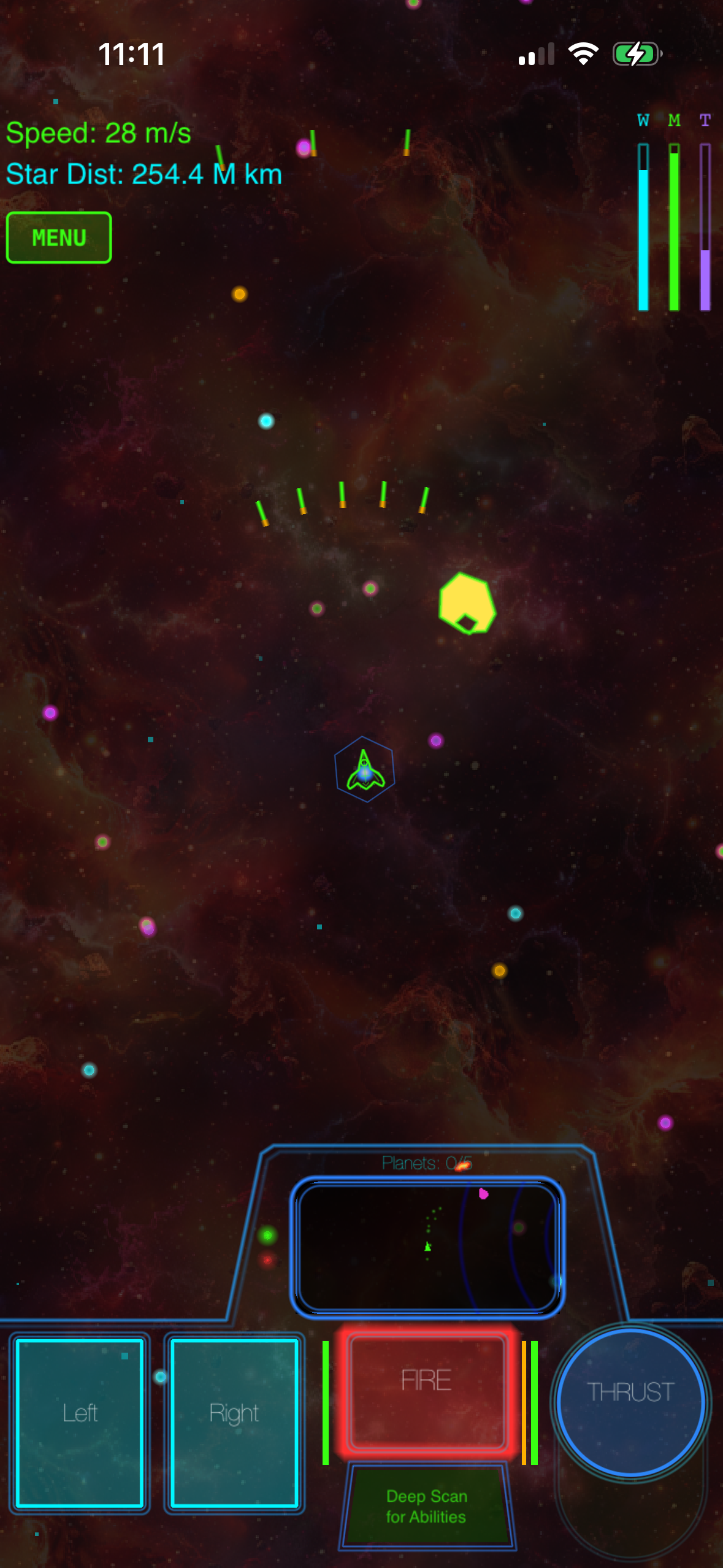
Galaximus models gravity accurately in real time. Every celestial body pulls on every other body. That means a planet’s gravity well is a tool—you can slingshot around it to gain speed for free, or let it capture you into orbit. The physics is the interface.
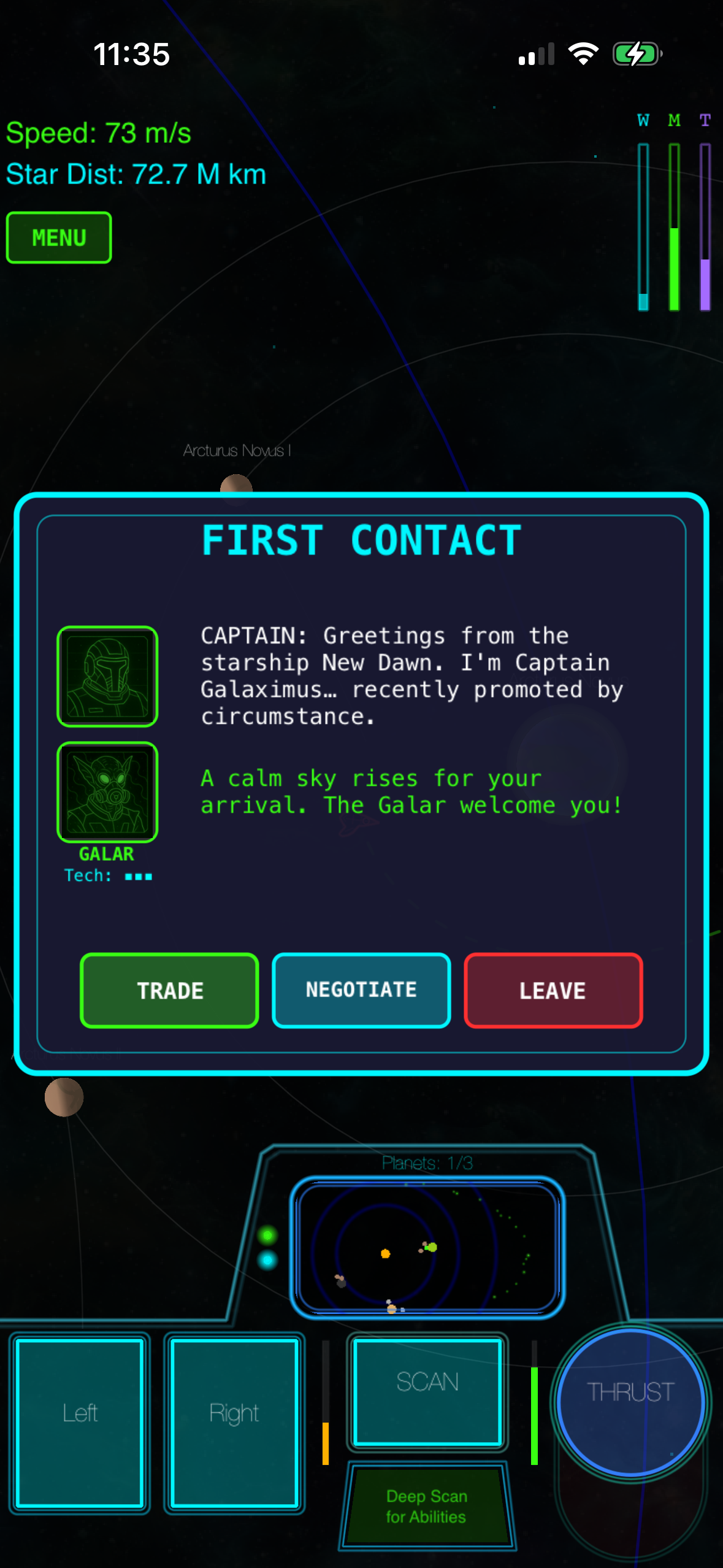
The campaign spans eight procedurally configured star systems. Each playthrough generates unique planet positions, so the puzzle changes. But the narrative arc is authored: you have a destination, encounters along the way, and a meaningful ending. After you finish, procedural systems let you replay it with different configurations.
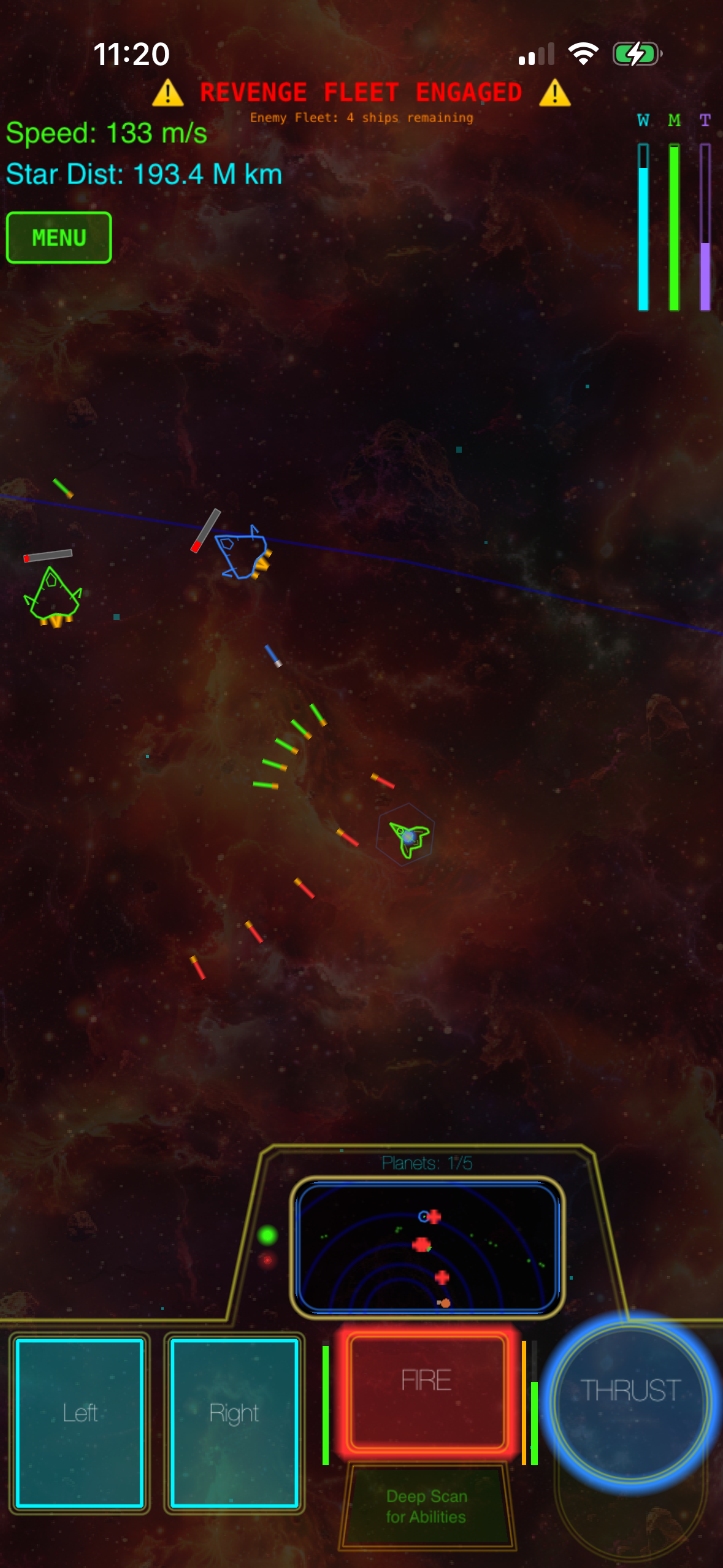
Combat exists but doesn’t dominate. You’ll encounter anomalies—derelict ships, distress beacons, spacetime rifts, and pirate fleets. Each is a self-contained encounter that tests your ability to use gravity and positioning as weapons.
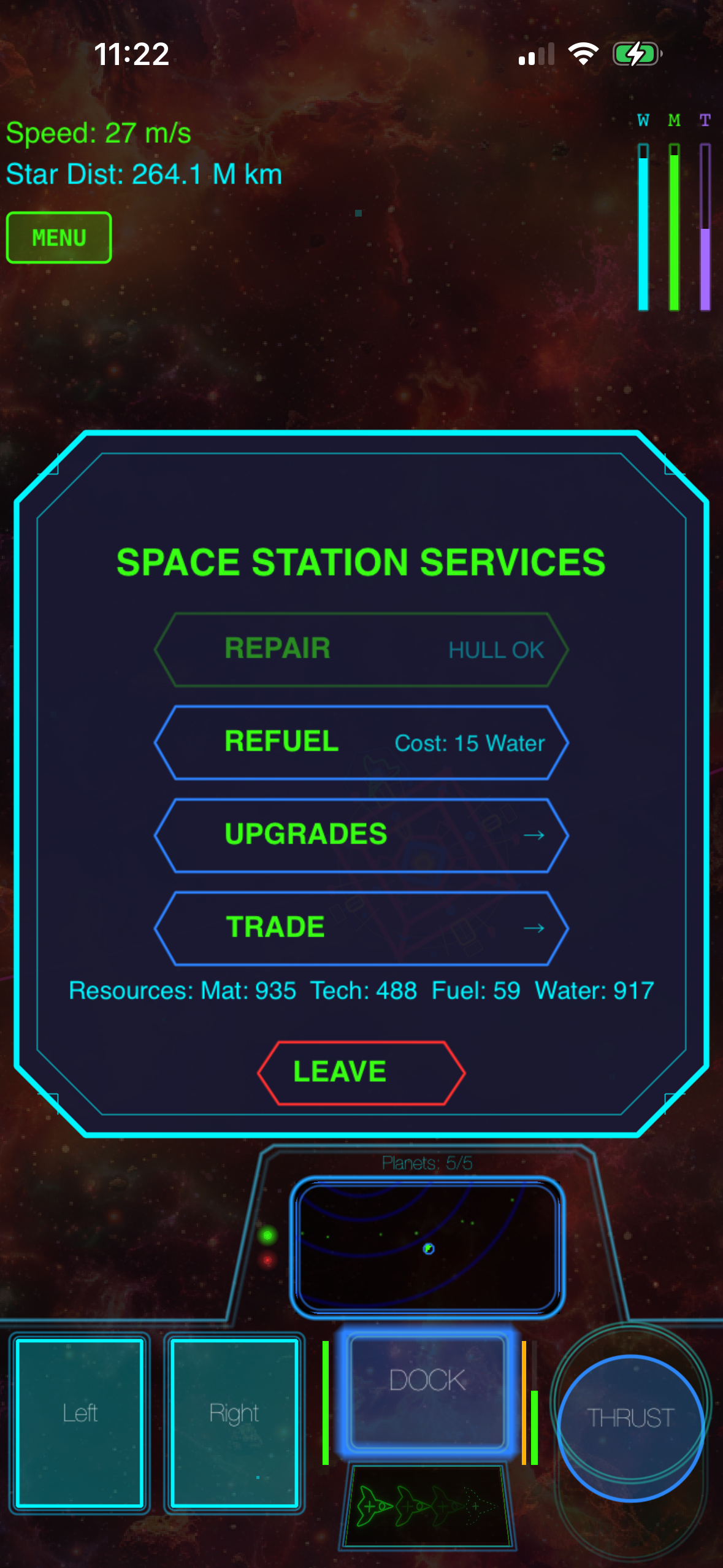
One-time purchase. No ads. No IAP. No energy meter. Play the campaign, replay it, or explore freely once you’ve finished.
Other Premium Space Games Worth Considering
Kerbal Space Program is the gold standard for rocketry simulation if available on your device. You build vehicles from components, manage fuel, and solve orbital mechanics problems like an engineer. It’s deeper than Galaximus—more granular, more systemic. The tradeoff: steeper learning curve, and the gameplay loop is design-and-test rather than pilot-and-explore. If you want to learn rocketry, KSP is unmatched. If you want to fly, Galaximus is faster to mastery.
Asteroids-lineage arcade games (like Asteroid Outpost) offer simpler controls and faster pickup-and-play than Galaximus. No learning curve—fire and move. If you want 5-minute sessions with immediate gratification, those fit better. But they don’t have narrative or campaign structure.
No Man’s Sky on iOS prioritizes procedural planet exploration and walking on surfaces. It’s a sandbox without a shaped ending. If you want to explore for hours without a goal, NMS is the choice. Galaximus is pilot-first, not walker-first.
Apple Arcade titles include space games bundled into the subscription (/month). Zero-friction onboarding if you’re already paying for Arcade. But you’re paying a monthly fee for a library rather than owning individual games. For space fans who want one focused experience, a premium purchase is usually better value.
Learning Curve: Who This Game Is For
Galaximus has a real learning curve. The first 20 minutes involve understanding how gravity works in the game’s context. You’ll crash into planets. You’ll overshoot orbital captures. You’ll waste fuel learning positioning.
This is intentional design, not a flaw. The learning curve is the price of the payoff. If you want a space game you can play without thinking, this isn’t it. If you want to learn something and feel it click—if you want to look at a gravity well and think “I can use that”—the curve is worth it.
Casual players expecting immediate mastery may find this frustrating. Players who enjoy systems-based learning will find it rewarding. Know which you are before buying.
Offline Play and No-Internet Gaming
All genuinely premium space games work offline. No server dependency, no check-in requirements, no “play offline but lose progress” mechanics. You own the game; it runs on your device.
Galaximus works completely offline. Download it, play it on a plane, on a train, in a cabin with no signal. No internet required, ever.
This is standard for premium games and shameful for free-to-play games that claim otherwise. If you’re paying upfront, offline play is a baseline expectation, not a feature.
FAQ
Can I play Galaximus on iPad? Galaximus is iPhone-only at launch. iPad support is on the roadmap for future updates.
How long is the campaign? Most players finish the eight-system campaign in 8–12 hours of play, depending on exploration and encounter replays. Procedural configuration means replays feel different.
What’s the file size? Verify current file size on the App Store before purchase, as updates may change it.
Does it work on iPhone 12 and older models? Check the App Store listing for minimum iOS version and device compatibility.
Is there multiplayer or online play? No. Galaximus is single-player only.
What’s the difference between Galaximus and Kerbal Space Program? KSP is an engineering simulator—you build rockets and solve orbital problems. Galaximus is an arcade action game with real physics—you pilot a ship and use gravity as your tool. Different design goals. KSP has more depth on rocketry; Galaximus has faster mastery and a shaped narrative.
The Case for Premium Space Games in 2026
The free-to-play model has optimized mobile gaming for engagement metrics, not for fun. Premium games—especially in niche genres like space exploration—are increasingly the only place you’ll find complete, uncompromised experiences.
Paying upfront for a space game means you’re buying a finished product. No ads to interrupt flow. No energy timers to halt progress. No cosmetics that hint at paid upgrades. The game’s design serves gameplay, not monetization.
If you want a space game that respects your time and your money, premium is the way.